ThaiBev’s Sustainability 2025
Home / Environmental
Water Stewardship
Water is the foundation of life and a key ingredient in all ThaiBev products, making it a cornerstone of our sustainable development focus. Around the world, increasing demand, pollution, and climate change are placing unprecedented pressure on freshwater resources. Droughts, floods, and other water-related crises are disrupting communities, ecosystems, and economies with growing frequency. Despite global commitments, progress toward SDG 6, “clean water and sanitation for all”, remains off track, highlighting the urgent need for collective action.

Recognizing the critical importance of water for life, communities, and business, ThaiBev embraces water stewardship as a core element of sustainable growth strategy. Across its global operations, the company is committed to using water efficiently, managing water-related risks, and advancing initiatives that replenish and protect shared water resources—ensuring a lasting balance between economic growth, social well-being, and environmental sustainability.
Management Approach
ThaiBev implements comprehensive water stewardship practices to ensure the long-term, sustainable use of water resources in support of both our operations and local communities. Our aim is to minimize potential impacts while fostering collaboration with key stakeholders— including government agencies, business partners, NGOs, and communities—to promote shared responsibility for water conservation. This approach encompasses the efficient use, responsible sourcing, treatment, and replenishment of water resources, alongside initiatives that advance Water, Sanitation, and Hygiene (WASH) to ensure equitable access to clean water and better health outcomes.

Endorsed by the Board of Directors, ThaiBev’s Corporate Water Management Policy outlines clear principles and guidelines to minimize water-related impacts from our production activities by assessing water quality and quantity, applying international water resource management tools and standards, adopting innovative technologies, and promoting responsible water consumption. The policy further extends to the sustainability of water sourcing—especially in water-stressed areas— ensuring that wastewater treatment serves as a key step toward sustainable sourcing and pollution prevention. ThaiBev does not consider marine-related resource commodities as a material topic.

Recognizing water stewardship as a material issue that strengthens the company’s climate resilience, ThaiBev systematically identifies, monitors, and manages water-related impacts, risks, and opportunities across its operations and value chain. Water data is analyzed using both internal forecasts and data from the National Hydroinformatics Data Center. Risk Coordinators at each facility review reports, assess risks, and implement mitigation measures, while significant risks are escalated to the Corporate Risk Management Committee for oversight.

Every three to five years, we conduct comprehensive physical risk assessments for all production facilities and supply chain locations to evaluate vulnerabilities under various climate change scenarios. These assessments inform Integrated Water Resource Management Plans (IWRM) for each site, reinforcing our commitment to reducing water consumption in water-stressed areas.

ThaiBev production facilities operate under the ISO 14001 international standard for environmental management, ensuring continuous improvement in water performance. Our wastewater is treated to exceed regulatory requirements—meeting higher standards for pH, temperature, COD, BOD, TSS, oil, and grease—before being discharged into natural water sources. Through these measures, ThaiBev minimizes ecological impact and contributes to the preservation of healthy aquatic ecosystems and sustainable oceans and seas.
Targets
Replenish
100%
water used in finished goods (beverage products) by 2040
Reduce
7%
water intensity by 2030 compared to 2023
Water Risk Management for ThaiBev Operations
ThaiBev conducts annual assessment of all production facilities using the World Resources Institute (WRI)’s Aqueduct Tools to evaluate exposure to water-stressed aMedium–High, High, and Extremely High. Facilities with risk levels categorized as High and Extremely High are prioritized and assessed for mitigation plans.

The result shows that 39 percent of ThaiBev’s production facilities (31 out of 80, including F&N production facilities) are located in areas with High and Extremely High water stress risk levels, posing potential financial or strategic impacts.
Percentage of production facilities in water-stressed locations
To address these risks, ThaiBev conducts the Water Sustainability Assessment (WSA) for both surface water and groundwater across all production facilities in Thailand to provide in-depth evaluations of present and future risks and opportunities. The assessment has led to the development of Integrated Water Resources Management Plan (IWRM) for each facility, focusing on implementing a long-term adaptation and mitigation plan. ThaiBev also collaborates with the Hydro- Informatics Institute (Public Organization) (HII) to conduct in-depth studies assessing the risks of floods and droughts under various climate scenarios, integrating findings into operational risk management and community engagement plans.
Water Risk Management throughout the Supply Chain
ThaiBev works with its suppliers in water-stressed areas to minimize water consumption. All significant suppliers are also assessed on water-related risks using WRI’s Aqueduct and the Together for Sustainability Initiative, as their operational disruptions could have substantial financial impact on ThaiBev. We have identified 49 out of the 108 locations (45 percent) of key agricultural commodity suppliers as operating in High and Extremely High water-stressed areas.
  • To quantify these risks, we identify products dependent on these key agricultural commodities and assess potential revenue loss from water-related supply chain disruption.
  • To mitigate risks, ThaiBev works closely with suppliers to secure supply continuity and requires them to track and report their water footprint and intensity annually. Additionally, we monitor and assess our suppliers’ water risks during the rainy season, through daily flood reporting via the CROSS SRM system.
Percentage of key agricultural commodities suppliers in water-stressed locations
ThaiBev has also established a Sustainable Agriculture Guideline to help suppliers optimize water consumption during their agricultural processes. Our suppliers are encouraged to measure their water consumption, identify opportunities to reduce their usage, conduct water risk assessments using internationally recognized tools, and implement mitigation plans in areas with significant water stress levels.
Water Risk Management Projects

Water Resource Management for Surrounding Communities, Thailand
Since 2022, ThaiBev has collaborated with the Hydro-Informatics Institute (Public Organization) (HII) on the “Water Resource Management for Surrounding Communities” initiative to assess the flood and drought risks in both the short and long term by using the HII’s Water Resource Information System for Sustainable Development. The initiative supports local communities around ThaiBev production facilities located in High and Extremely High water-stressed areas, within a five-kilometer radius of each facility. Through this project, ThaiBev is able to operate its business while creating value for the communities that share the same water sources by devising a mitigation action plan for water-related risks within and outside its operations.

The study process includes:
  • Assessing the general condition of the area, the watershed condition, and meteorological and hydrological data—including potential sources of water pollution—to assess the flooding and drought situation, including historical occurrences of such events.
  • Analyzing the impacts of climate change on flood and drought issues, including the indices and trends in extreme rainfall data for current and future conditions. Creating a probability map for extreme rainfall in the catchment area and its associated watershed areas around the facility.
The initiative has been implemented at Beer Thai Brewery in Kamphaeng Phet Province, Thanapakdi Distillery in Chiang Mai Province, Simathurakij Distillery in Nakhon Sawan Province, and ThaiDrinks Non-Alcoholic Beverage production facility in Lampang Province, all located in Extremely High water-stressed areas. In 2025, the initiative expanded to include Oishi Trading Wang Muang production facility and F&N Dairies (Thailand) production facility in Saraburi Province.
Key Results of the Study Thanapakdi Distillery, Chiang Mai Province
Flood risk in the area is generally low, with only 15 percent of the area classified as high to very high risk due to its location within an irrigation zone. Drought risk remains significant, affecting 50 percent of the area, particularly agricultural land situated outside the irrigation zone. Climate change projections suggest that flood risk may increase in both spatial extent and intensity, while drought risk could decrease, highlighting the importance of adaptive water management strategies.

Simathurakij Distillery, Nakhon Sawan Province
The study area is more vulnerable to drought than to flooding. Approximately 63 percent of the area is at high drought risk, with nearly 99 percent within a five-kilometer radius considered highly vulnerable due to its location outside the irrigation zones and the predominance of agricultural land. The facility mitigates these risks through a reliable water supply from storage ponds and groundwater wells. Climate change projections indicate increasingly variable rainfall, with potential rises in flood frequency, while drought-prone areas may decrease in size, underscoring the need for proactive water resource planning.

ThaiDrinks Non-Alcoholic Beverage Production Facility, Lampang Province
Flood risk is generally low due to effective irrigation management, while drought risk is moderate, with 31 percent of the watershed classified as high risk. The facility maintains a reliable water supply through storage ponds and groundwater wells. Climate change projections suggest stable or slightly reduced drought risks, with minor increases in flood exposure, reinforcing the need for adaptive water and risk management strategies.

Automated Telemetry Station Installation Project for Monitoring Rainfall and Water Levels in Headwater Forests of the Ping, Wang, Yom, and Nan River Basins
To strengthen real-time water monitoring and disaster preparedness and demonstrate ThaiBev’s commitment to water stewardship, enhancing readiness and promoting sustainable water security for both communities and society, ThaiBev supported the installation of 72 automatic telemetry stations in collaboration with the Utokapat Foundation under the Royal Patronage of H.M. the King and the Hydro-Informatics Institute (Public Organization) (HII). This initiative, launched in celebrating the Auspicious Occasion of His Majesty the King’s 6th Cycle Birthday Anniversary, aims to enhance water resource management in northern Thailand’s headwater forests, focusing on the Ping, Wang, Yom, and Nan River Basins across 11 provinces. The telemetry stations collect real-time data on weather conditions, rainfall, and water levels, which are accessible via the National Hydroinformatics Data Center and the ThaiWater mobile application for timely monitoring and disaster response.

To complement the initiative, a workshop on “Monitoring Rainfall and Water Levels from Automatic Telemetry Stations” was organized to provide practical knowledge in using telemetry systems and hydrological data for accurate water situation analysis and disaster preparedness. The training was attended by 40 participants from various ThaiBev business units, including the staff from ThaiBev Situation Room (TSR) and community development teams, strengthening internal capacity for effective water risk management.
Key Projects

Water Replenishment Projects
ThaiBev recognizes that water challenges vary across locations, which means that water management must be carried out in accordance with local contexts. The company prioritizes infrastructure improvements for water replenishment projects and enhances water resource security by using the Volumetric Water Benefit Accounting (VWBA) methodology to measure and monitor the effectiveness of operations to ensure that ThaiBev’s water management has a sustainable positive impact on communities and the environment.
Community Water Management Project in accordance with the Royal Initiative of Muang Mae Haad Community, Thailand
ThaiBev, in collaboration with the Hydro-Informatics Institute (Public Organization) (HII), implemented the Mae Haad Weir Rehabilitation Project to improve the local water system in the Muang Mae Haad community. The project covers three villages—Ban Mae Hoy, Ban Muang Klang, and Ban Ku Ho—in Ban Luang Sub-district, Chom Thong District, Chiang Mai Province, and aims to address water scarcity for both agricultural and household use, particularly during the dry season.

In 2025, the project successfully increased the water delivery efficiency for agriculture areas from 10 rai per day to 15 rai per day—a 50 percent increase. This increase enables dry-season cultivation across 652 rai, nearly matching the 775 rai cultivated during the rainy season. The project also provided household water supply to 139 households, totalling approximately 22,500 cubic meters per year, or an average of 162 cubic meters per household per year. In total, the initiative delivered 49,750 cubic meters of water annually, supporting both agricultural production and daily consumption needs.

This outcome demonstrates the project’s success in strengthening water security and resilience for the Muang Mae Haad community. By improving access to reliable water resources, the initiative supports sustainable agriculture, enhances community livelihoods, and contributes to long-term water sustainability.
Water Conservation at Bung Jagoi Heritage Village, Malaysia
F&NHB’s Borneo Springs mineral water, which is sourced from a 130-million-year-old rainforest, partnered with the Jagoi Heritage Association (JHA), through its Jagoi Area Development Committee (JADC), to provide a sustainable water supply to Bung Jagoi Heritage Village in Kuching, Sarawak, Malaysia. The initiative, which focuses on water conservation and forest rehabilitation, including the installation of a new water pump system drawing clean water from Ayak Tibodak and the repair of water storage tanks, is expected to replenish up to 5.475 million liters of water annually. This initiative strengthens long-term water security for the village while supporting eco-tourism and the preservation of its cultural heritage.
Area-Based Development Project in Chiang Dao, Thailand
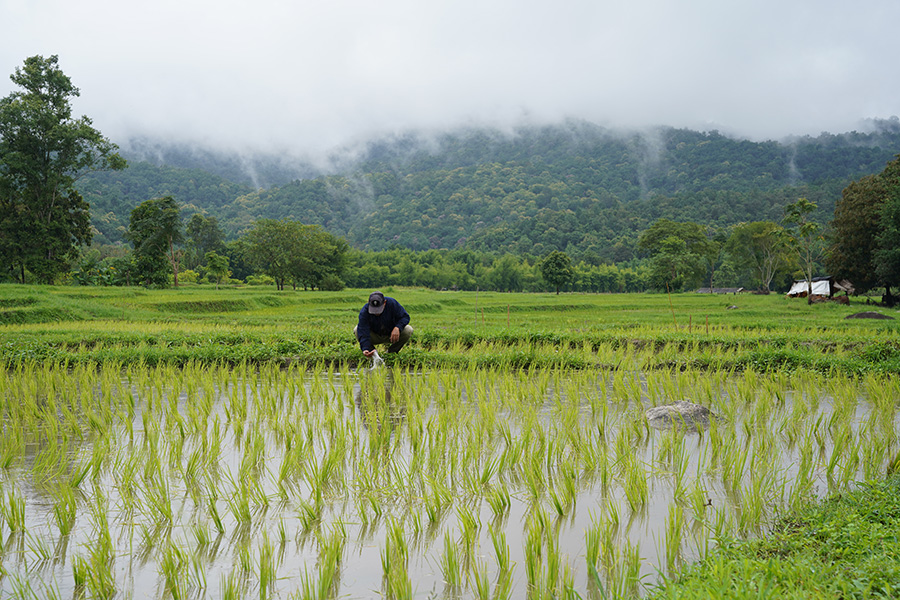
ThaiBev, in collaboration with the Mae Fah Luang Foundation under Royal Patronage, implemented an area-based development initiative in Chiang Dao District, Chiang Mai Province. The initiative focused on the Khilek Weir Rehabilitation Project in Ban Chomkiri, Mae Na Sub-district, which aims to develop efficient local water systems and replenish water to nature and surrounding communities. The project has adopted the Sufficiency Economy Philosophy (SEP) in Action and a community participatory approach. Local residents were engaged throughout the process, beginning with the area survey, through problem identification, to solution development and the weir rehabilitation. Community members played an important role in both contributing labor and establishing a Community Water Fund to support the ongoing maintenance and development of the water system. This participatory model has fostered a strong sense of ownership among community members and laid the foundation for long-term water sustainability.

Following the rehabilitation, the Khilek Weir—serving as an agricultural water source—now provides irrigation for 115 rai of farmland, benefiting 29 farming households. The improved water access has enabled farmers to expand their cultivated crops from four to six types, including rainy-season rice, dry-season rice, sesame, longan, mango, and sweet corn, thereby contributing to increased agricultural productivity. As a result, the community’s total annual income increased by more than 47 percent, from 556,363 Baht to 816,163 Baht. In addition, the project successfully replenished 19,643.5 cubic meters of water to nature and the community, calculated in accordance with the VWBA international standard, based on crop water requirements per rai.

Beyond economic and environmental outcomes, the project also created social value by strengthening community capacity in water governance. Through the Community Water Fund, local members jointly plan, maintain, allocate, and manage water resources with transparency and accountability, enhancing their preparedness for future water-related risks.

The Khilek Weir Rehabilitation Project exemplifies effective collaboration between the private sector and local communities. It demonstrates ThaiBev’s continuous efforts to advance sustainable water management, support community resilience, and contribute to the United Nations Sustainable Development Goal (SDG) 6: Clean Water and Sanitation.

Water Usage Reduction Projects
ThaiBev manages water efficiency in its production processes by focusing on increasing water efficiency, reuse, recycling, and wastewater treatment. The company has committed to reducing water intensity per production unit and promoting the reuse and recycling of freshwater. These efforts aim to reduce water withdrawals, maintain ecological balance, and enhance the long-term sustainability of water resources.
Rainwater Harvesting System in Vietnam
At SABECO’s Cu Chi and Can Tho Breweries, the installation of rooftop rainwater harvesting systems has reduced water withdrawals from natural resources by 12,588 cubic meters during rainy seasons and saved 172,420 Baht annually. SABECO plans to expand the initiative to all its breweries in the future to improve water efficiency and promote sustainable water resource management in the long term.

Effective water management in 2025 resulted in the reduction, reuse, and recycling of water, compared to the total volume of water withdrawal, as follows:


Water for Communities Projects
ThaiBev collaborates with local and global partners to expand the positive impact of its water management and promote watershed conservation in water-stressed areas. The company also supports Water, Sanitation, and Hygiene (WASH) initiatives across its operating regions, including Thailand, Myanmar, and Vietnam, to improve the quality of life of communities and create long-term sustainability of water resources.
Clean Water for Communities
ThaiBev’s ongoing “Clean Water for Communities” and “Clean Drinking Water” programs in schools and communities around our production facilities in Thailand have provided safe drinking water to over 13,500 people. We have successfully completed 41 WASH projects across 11 provinces, including Pathum Thani, Chon Buri, Buriram, Prachin Buri, Ratchaburi, Uttaradit, Surat Thani, Nakhon Pathom, Ubon Ratchathani, Ayutthaya, and Nakhon Sawan Provinces. The company has also initiated a similar program in Myanmar to continuously improve quality of life and create long-term sustainability of water resources.

Water Irrigation Initiative for Local Farmers at San Hpe Model Village, Myanmar
The Grand Royal Group (GRG), ThaiBev’s subsidiary, supported farmers in San Hpe Village with solar-powered irrigation, providing 1,500 cubic meters of water daily for 177 rai (28.3 hectares) of paddy fields, increasing yields and reducing irrigation costs by 50 percent. As a result, the project has produced 7,000 baskets of paddy equivalent to 150,000 kilograms increasing the income of ten landowners to a total of 620,955 Baht. Additionally, a solar-powered RO water treatment plant supplies 3,000 liters of clean water per day for local use and income-generating activities.
Achievements
Increasing the amount of water for communities
446,910
cubic meters of water replenished for communities in 2025

Water usage efficiency in the production process
17%
reduction in water intensity in 2025 compared to 2023
(the 2030 intensity reduction target is 7% in comparison to the base year 2023)

Beverage business water intensity
2.68
hL/hL
  • All employees in production facilities received awareness training on water efficiency management.
  • All ThaiBev factories in Thailand completed Water Sustainability Assessment for surface water and groundwater.
  • Zero water-related incidents since 2012 due to our stringent efforts to control our environmental impacts and our close relationships with surrounding communities.
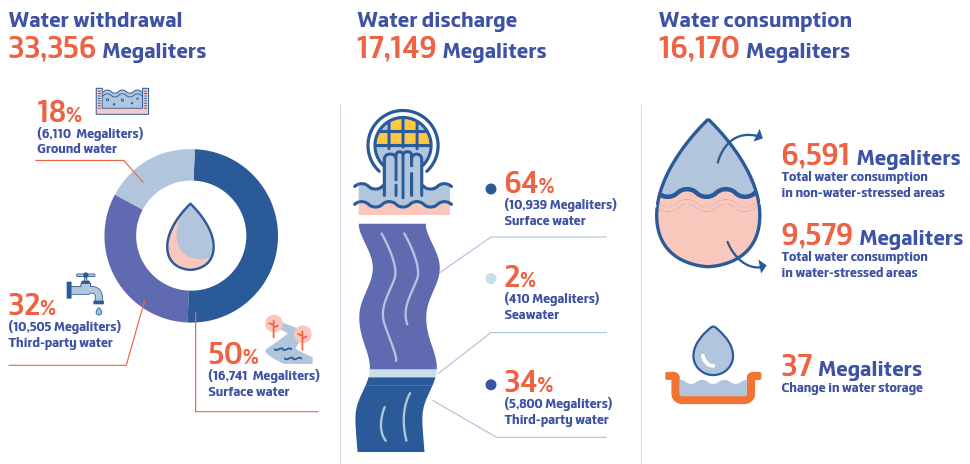
Water Resources Data in FY2025
Moving Forward
Next year, ThaiBev will implement site-specific water management plans at the production facilities which are located in Extremely High water-stressed areas and where Water Resource Management for Surrounding Communities assessments have been conducted in collaboration with the Hydro–Informatics Institute (Public Organization) (HII). These facilities include Beer Thai Brewery in Kamphaeng Phet Province, Thanapakdi Distillery in Chiang Mai Province, Simathurakij Distillery in Nakhon Sawan Province, and the ThaiDrinks Non-Alcoholic Beverage Production Facility in Lampang Province. In parallel, ThaiBev will continue its collaboration with HII to assess through future precipitation simulations how climate change is increasing the risk of floods and drought at the Oishi Trading Wang Muang production facility and the F&N Dairies (Thailand) production facility in Saraburi Province. Findings from these assessments will inform the development of site-specific water management strategies to further strengthen resilience.

Additionally, ThaiBev’s breweries in Vietnam will expand rainwater harvesting initiatives to further reduce water withdrawals from natural sources. The company has also conducted water stress assessments for critical suppliers and will work to develop water management plans with those whose production sites are located in High to Extremely High water-stressed areas.

Read More Information about
Water Stewardship
in Sustainability Report 2025