ThaiBev’s Sustainability 2025
Home / Governance & Economic
Corporate Governance and Business Ethics
ThaiBev strictly adheres to its Code of Business Conduct while maintaining an efficient management system. The Company conducts business with integrity, responsibility and fairness in order to gain trust from all stakeholders. ThaiBev’s business practices have helped it gain a competitive advantage.

ThaiBev emphasizes the importance of Board diversity to ensure that the Board can discuss and make decisions effectively by taking into account all issues relating to its business operations that affect ThaiBev and its stakeholders, including the social, environmental, and human rights impacts on its business, in order to achieve the Company’s strategic objectives and sustainable growth and development.
Management Approach
ThaiBev is committed to embracing principles of good corporate governance in accordance with its Code of Business Conduct and all applicable laws, rules, and regulations, including the Listing Manual of Singapore Exchange Securities Trading Limited (“SGX”) and the principles and provisions of the Code of Corporate Governance 2018 of Singapore. The Company aims to excel in its sustainability and risk management efforts, which are in line with sustainability development guidelines. It seeks to adequately disclose information to build confidence among shareholders, investors, employees, customers, and all other stakeholders. ThaiBev is dedicated to meeting all of its customers’ needs, and also to providing its stakeholders with stable, sustainable, value-added growth over the long term.

The Board is responsible for organizational leadership, setting up the direction, strategy, and operational objectives for the long-term success of the ThaiBev group of companies, both domestic and overseas (“ThaiBev Group”). The leadership team seeks to ensure that ThaiBev operates in accordance with its business plan, which is created with input from its shareholders. ThaiBev’s business plan also ensures that the Company operates in good faith and in compliance with all applicable laws, rules and regulations. Lastly, it makes sure that the companies in ThaiBev Group comply with applicable regulations of SGX and other related stock exchanges. (For more information on ThaiBev’s organizational structure and corporate governance, see ThaiBev’s 2025 Annual Report at http://www.thaibev.com.)

At the joint Audit Committee and Sustainability and Risk Management Committee Meeting held in 2025, the Company had arranged for the Singapore Institute of Directors (SID) to conduct a training session for the Board, Audit Committee, Sustainability and Risk Management Committee, as well as management teams of the companies in ThaiBev Group, to develop their expertise and knowledge in Environmental, Social, and Governance (ESG) matters.

In addition, on 20 June 2025, ThaiBev held its Annual Information Meeting (“AIM”) in Singapore to provide an opportunity for our shareholders in Singapore to meet with the directors and senior management of ThaiBev Group. Our Group CEO, as well as members of our senior management, delivered a comprehensive presentation covering the business and operations of ThaiBev Group, financial highlights, and our key product groups.

The attendees were able to participate in the question- and-answer session on the business and operations of ThaiBev Group with ThaiBev’s key directors and senior management during the AIM. ThaiBev also promptly made available the presentation slides shown during the AIM on the SGXNet to ensure that all shareholders of ThaiBev were kept updated. Lastly, to emphasize its commitment to listening to feedback, ThaiBev has initiated a whistleblowing policy and contact channel for receiving complaints from ThaiBev’s directors, executives, and employees. In 2025, no significant conflicts or ethical complaints were received via email at Whistleblowing@thaibev.com.

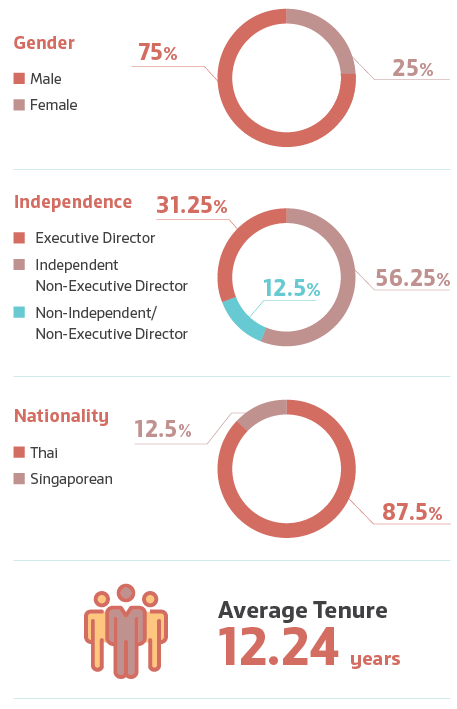
Board of Directors Composition

Code of Business Conduct
ThaiBev established its Code of Business Conduct to pursue integrity, legal compliance, morality, and ethics, including prevention of conflicts of interest. The company has implemented rules on prevention of conflicts between personal and collective interests.

As mentioned in Article 4.1 (2) of Business Ethics of Thai Beverage Group regarding responsibilities to the company, the employees shall not engage in any action which may cause a conflict of interest with those of the company, or perform any action leading to the loss or the reduction of the company’s expected benefit, or appropriating the benefit away from the company. In addition, Clause 15 of the employment contract stipulates that, while employed by the company and within one year of leaving, employees must agree not to do the following, except with the written consent of the company:

15.1 Hire or be an employee of a juristic person or business that is competitor of the Company and/or the Group of Companies.

15.2 Provide any advice, consultation or assistance, or contract with any entity or business of any person that is a competitor of the Company and/or the Group of Companies, which may cause or damage to the business or affairs of the Company and/or Group of Companies.

15.3 Operate the same or similar business as the business of the Company and/or the Group.

ThaiBev has a duty to maintain transparency in its operations, to protect the interests of its shareholders by considering present and future market conditions and risk factors, and to treat employees, customers, and business partners ethically. The company is committed to ensuring that its personnel understand, accept, and follow its Code of Business Conduct.

This will positively support:
  • the company’s ability to uphold its responsibility to society and stakeholders
  • employees’ work efficiency
  • fairness within the organization
  • employees’ dignity and integrity
  • the company being socially accepted
  • employees’ well-being.
There are three groups of communication channels to report ethical concerns in business:
  • 1. Communication channels for employee relations and complaints handling
  • 2. Communication channels for customers and consumers– customers and consumers can file any concerns via the Dhospaak call center service
  • 3. Communication channels for suppliers and business partners–our suppliers and business partners can submit any feedback or concerns to the Procurement Service Center (PSC)
In 2025, the company found a total of 83 cases of disciplinary violations related to the Code of Business Conduct. There was one case related to harassment.

Anti-Corruption
Corruption is a criminal offense that affects free competition and breaches the company’s Code of Business Conduct. It causes damage to ThaiBev’s reputation, stakeholders’ confidence, and the company’s profits. In order to ensure policy compliance, it is mandatory for all employees to have training on anti-fraud and anti-corruption, and the legal consequences or employee disciplinary actions that will arise from fraudulent conduct and corruption.

ThaiBev operates the business in accordance with the principles of good corporate governance, with fairness and adherence to the Business Ethics of Thai Beverage Group, as well as upholding the best interests of stakeholders related to our businesses in Thailand and overseas. ThaiBev’s anti-corruption policy establishes protection measures and serves as a guideline to create a stable and sustainable growth.

The Group CEO is required to monitor and set up an effective system for supporting anti-corruption actions, and to report to the Chairman of the Board of Directors and the Audit Committee; and to review and present the revised Policy which is updated to be consistent with business changes, regulations, standards, and laws.

The company has specified the roles and duties of all parties as follows:
  • Group CEO and executives are accountable for promoting, creating common understanding of, and supporting relevant persons to comply with the Policy.
  • Directors, executives and employees have the duty to maintain the highest standards of business conduct.
  • Employees must not neglect evidence or any course of action that is linked to any corruption.
  • Employees must cooperate in investigating the facts.
Failure to act in accordance with ThaiBev’s anti-corruption policy is a severe disciplinary offense, violates the company’s employment contract, and is a criminal offense. Violating the anti-corruption policy can cause severe damage to the company’s reputation. If corruption is discovered, an employee has an obligation to report such action to their supervisors. A person committing corruption will be punished according to ThaiBev’s rules and legal proceedings may be initiated against such person accordingly.

The company conducts a transparent and rigorous investigation process as stipulated in the code of conduct, which also stipulates fair and reasonable penalties for employees who fail to comply with the policy. In fiscal year 2025, there were 83 minor cases of employees failing to act in accordance with ThaiBev’s anti-corruption policy. Most of them involved using or exploiting a position that had been assigned by ThaiBev in a wrong way. All the cases resulted in termination penalty. There were no corruption cases committed by business partners.

Handling Complaints
ThaiBev encourages all employees to report any well-founded suspicions of wrongdoing through the company’s contact channel for receiving complaints. Employees will not be victimized or subject to any detriment if they raise legitimate concerns in good faith.

The process of filing complaints is as follows:
  • If a Director has concerns, the Director should consider reporting them to the Chairman of the Audit Committee.
  • If an employee has concerns, the employee should report through the recommended channel in writing with the employee’s name and contact details, and should raise his/her concerns in writing with his/her supervisor/department/division/office head.
  • Where the matter is more serious, an employee should raise the concerns with the Office of Group CEO via email at whistleblowing@thaibev.com.
  • ThaiBev will take reasonable steps to protect employees who report their concerns in good faith. Confidentiality will be maintained and suspected wrongdoings within ThaiBev will be taken seriously.
  • Once an employee has reported his/her concern, the matter will be assessed to determine the proper action to be taken, which might include internal investigation or a referral for external investigation.
  • Any complaint that is later found to be false, or in bad faith, or with malicious intent, or in a careless manner, or for personal benefit is considered gross misconduct which leads to disciplinary actions as stated in the Employee Handbook of ThaiBev.

Breaches of Regulations and the Law
ThaiBev requires that all employees comply with its rules and regulations, and the laws of the countries that the company operates in. Any breach of applicable regulations in terms of ethics, organizational standards of excellence, or violations of human rights on the business premises must be stopped immediately and appropriate measures taken. In 2025, some cases were reported (breaches are categorized by the monetary value of the action: major cases involve a monetary value of 300,000 Baht or more; minor cases involve less than 300,000 Baht). To prevent breaches of the regulations,

ThaiBev has implemented the following procedures:
  • Conduct orientation for new employees and executives.
  • Provide online training courses for employees.
  • Communicate business ethics to employees.
  • Require all empl oyees to follow Business Ethics of Thai Beverage Group.
  • Take decisive action when fraud is discovered as it may involve legal action.
  • Conduct regular internal audits by the Internal Audit Office to ensure that ThaiBev follows rules and regulations under the law.

Adapting to Regulatory Changes
To enhance ThaiBev Group’s readiness to adapt to regulatory changes and ensure complete compliance with government regulations in all dimensions, ThaiBev Group continuously monitors, researches, and analyzes relevant regulation and draft legislation, both in Thailand and in other countries where it has investments and business operations. This process relies on diverse and reliable information sources, including the Thai Government Gazette website—the official government platform for publishing regulation, orders, and key announcements— as well as the websites of regulatory authorities and relevant agencies such as the Office of Alcohol Control Committee, the Department of Disease Control, the Ministry of Public Health, the Excise Department, the Pollution Control Department, the Revenue Department, the Secretariat of the Prime Minister, the Secretariat of the Cabinet, the Secretariat of the House of Representatives, and the Office of the Council of State. In addition, the company utilizes the Central Legal System and the Public Consultation System of the Parliament, which provide access to information on draft legislation, public hearings, and assessments of the effectiveness of existing laws. We also keep track of developments through Cabinet meetings and through our active participation in leading national business associations, including the Thai Chamber of Commerce, the Board of Trade of Thailand, and the Federation of Thai Industries. These efforts enable ThaiBev Group to obtain accurate, comprehensive, and up-to-date legal information for assessing potential impacts and establishing practical guidelines that align with governmental requirements, thereby supporting ThaiBev Group’s business operations to be efficient, transparent, and sustainable.

In the past year, ThaiBev Group enhanced its operational capabilities to effectively respond to increasingly complex and evolving legal and regulatory changes. ThaiBev Group focused on leveraging modern digital technologies to strengthen efficiency and support risk management in alignment with its corporate governance framework, by using electronic tools and artificial intelligence (AI) to support legal operations. This included the implementation of legal and case law research systems, digital document management systems that improve accuracy and retrieval speed, and systems for monitoring and alerting trademark registration renewal deadlines. These technological advancements align with PASSION 2030–Digital for Growth, ThaiBev Group’s strategic initiative that emphasizes the use of technology to enhance operational efficiency, mitigate risks, and drive organizational growth, while upholding strong emphasis on the ethical use of AI in accordance with its Artificial Intelligence Policy (AI Policy), ensuring that technology adoption is conducted responsibly, transparently, and with due consideration for all stakeholders.

To ensure a systematic approach in adapting to regulation and governmental policy changes,

ThaiBev Group has established a workstream on regulatory change risk management, which outlines the following operational guidelines:
  • Legal Operations Workstream
    Monitoring of subordinate legislation under review by relevant government agencies, communication through industry associations, chambers of commerce, and other private sector channels, and participation in public hearings and clarification sessions organized by government authorities, when applicable. These efforts aim to ensure access to accurate and timely legal information, mitigate legal risks, and strengthen ThaiBev Group’s readiness.
  • Business Operations Workstream
    Identification of business risks and opportunities arising from regulatory changes, and coordination with internal departments to implement actions and report progress, with the objective of enabling the business to adapt promptly and leverage new legislation as a strategic opportunity.
  • Communication Workstream
    Organization of training sessions and meetings for supervisors and relevant employees to systematically communicate key legal matters, with the objective of ensuring that all relevant personnel at every level understand new requirements and comply accurately.
In 2025, several new laws were enacted by government authorities, representing key factors that will impact ThaiBev Group’s future business. ThaiBev Group has therefore undertaken measures to adapt to these regulatory changes in alignment with its strategic objectives as follows:
The Excise Tax Act (No. 2), B.E. 2568
The Excise Tax Act (No. 2) B.E. 2568 was published in the Thai Government Gazette on 5 June, 2025 and came into effect on 6 June, 2025. It is an amendment to the Excise Tax Act B.E. 2560, specifically revising Section 153, which establishes the framework for the issuance of rules, procedures, and conditions related to the application for and issuance of licenses to produce liquor or to possess distillation equipment for liquor production to ensure appropriate regulation of business operations, for example setting rules, procedures, and conditions for license applications that take into account liquor production standards. It also encourages cooperatives, agricultural groups, community enterprises, agricultural organizations, or small operators to obtain licenses to produce liquor for commercial purposes, using domestically-produced agricultural products to produce all types of liquor, which may be colored or flavored. The amendment to Section 153 requires the Excise Department to repeal the Ministerial Regulations on Liquor Production B.E. 2565 and other currently effective subordinate legislation. New subordinate legislation must be issued in accordance with the provisions of this amendment within 180 days from the date this act comes into effect.

In response to changes in the Excise Tax Act, ThaiBev Group has adapted and developed a comprehensive business strategy with a focus on enhancing the quality and standards of existing products, developing new products to meet diverse consumer demands, and strengthening brand recognition. Furthermore, ThaiBev Group is committed to reinforcing its distribution system to ensure efficient access to consumers across all regions, thereby increasing competitiveness and maintaining a strong, sustainable position in the market amidst new entrants.
The Alcoholic Beverage Control Act (No. 2), B.E. 2568
The Alcoholic Beverage Control Act (No. 2), B.E. 2568 was published in the Thai Government Gazette on 9 September, 2025 and came into effect on 8 November, 2025. It is an amendment to the Alcoholic Beverage Control Act B.E. 2551, intended to ensure that alcoholic beverage control measures remain appropriate and responsive to current circumstances, while supporting the evolving economic and social context. The amendment includes provisions that relax certain restrictions, tighten others, and leave some details pending further clarification through subordinate legislation. As a result of this amendment, new subordinate legislation must be issued to establish rules, procedures, and specific details in accordance with the revised provisions. The preparation and promulgation of such subordinate legislation are required to be completed within one year from the date this act comes into effect.

The amendments to the law are expected to have both positive and negative impacts on ThaiBev Group. Accordingly, ThaiBev Group has adjusted its business strategies to align with the revised regulation provisions. For provisions that relax certain restrictions, ThaiBev Group will collaborate with suppliers and business partners to explore opportunities for product sales through new channels permitted under the amended act, ensuring that all activities are appropriate, legally compliant, and socially responsible. For provisions that impose tighter requirements, ThaiBev Group will communicate the revised regulations to relevant employees to ensure proper compliance, while also providing guidance to business partners and other stakeholders on adhering to the new legal requirements. For provisions that await clarification through subordinate legislation, ThaiBev Group will closely monitor the issuance of relevant subordinate legislation, assess their potential impact on the business, and adjust operational strategies accordingly to ensure continued compliance and alignment with the revised legal framework.

Support for Trade Associations and Civil Society
The Thai Chamber of Commerce and Board of Trade of Thailand
ThaiBev works with the Thai Chamber of Commerce and Board of Trade of Thailand, a national Chamber of Commerce established by a collaborative network of entrepreneurs and business leaders, to serve as the coordinating agency between the government and the private sector to voice, drive and connect policy agendas of the private sector with important government policies in order to enhance entrepreneurial potential. In 2025, ThaiBev sponsored “Unlocking SMEs for Sustainable Future”, a series of events organized by the Thai Chamber of Commerce and Board of Trade of Thailand, and its partner organizations, to enhance the capabilities of SMEs in Thailand.
Thailand Institute of Packaging and Recycling Management for a Sustainable Environment (TIPMSE), under the Federation of Thai Industries
ThaiBev actively supports the Extended Producer Responsibility (EPR) program in Thailand and is committed to establishing an efficient closed-loop post-consumption packaging management system. As part of the Thailand Institute of Packaging and Recycling Management for a Sustainable Environment (TIPMSE), a non-profit organization founded by industrial clubs under the Federation of Thai Industries, ThaiBev takes an active role in promoting sustainable packaging management. ThaiBev collaborates with stakeholders across the packaging value chain, including academic researchers, private companies, and key packaging suppliers. Beyond providing financial support, ThaiBev, as one of the major drivers of the EPR scheme, is in charge of managing the PACKBACK pilot project in Chon buri province and data collection on glass recycling to support the development of a national packaging database. ThaiBev has also dedicated one of its used packaging collection sites as a hub for TIPMSE’s PackBack pilot program, which advances the EPR scheme.
The Federation of Thai Industries (FTI)
The Federation of Thai Industries (FTI) brings together industrial leaders to formulate, voice, protect, and promote the interest of members in Thailand’s industrial sector to help promote and develop industrial enterprises, to work with the government in setting up national policies, and to offer consulting services to members. Every year, ThaiBev supports the operations of the FTI, including sponsoring various events, supporting membership fees, and giving research grants related to packaging management. ThaiBev advocates that all sectors separate used packaging from waste to help reduce environmental impacts. The company believes that these initiatives will help packaging to become more sustainable, under the concept of packaging as a raw material.
Thailand Management Association (TMA)
ThaiBev is committed to participating in activities with non-profit organizations to help enhance competitiveness at both the corporate and national levels. There are ThaiBev executives on Thailand Management Association (TMA)’s Committees. In addition, ThaiBev continues to support the TMA’s budget for activities such as seminars on technology and innovation. In 2024, ThaiBev supported the TMA 60 Years of Excellence event that offered to connect with global and regional leaders from several prominent organizations, as well as experts from across all sectors for active networking, community engagement, and contributing to the competitive future of ASEAN and Thailand.
UN Global Compact and Global Compact Network Thailand
Recognizing the importance of sustainable development in the private sector, ThaiBev joined the UN Global Compact (UNGC) on 24 July, 2019. The UNGC is the United Nations’ framework for sustainable development cooperation.

It aims to strengthen cooperation amongst companies in all industry sectors, foundations, and non-profit organizations and encourage all parties to be mindful of sustainability in their operations in line with the UNGC’s ten global principles. These ten principles cover four key dimensions: anti-corruption, labor standards, human rights, and environmental protection. ThaiBev recognizes that the protection and conservation of natural resources and the environment are key to sustainable development. Therefore, it is committed to operating in accordance with circular economy principles. It is also dedicated to continual development of more efficient and environmentally friendly practices in energy, water, packaging materials, and waste.

ThaiBev foresees that its commitment will further increase as a member of the Global Compact Network Thailand (GCNT) to help achieve UN Sustainable Development Goal 17. In 2025, ThaiBev has sponsored and participated in “GCNT Expo 2025: Forward SDGs Faster Together”, accelerating national progress toward achieving the UN Sustainable Development Goals (SDGs) by 2030.
Thailand-Vietnam Business Council (TVBC)
To strengthen Thailand-Vietnam relationships and drive collaboration to overcome business challenges to enhance trade and investment opportunities for mutual prosperity of both countries, ThaiBev actively supports Thailand-Vietnam Business Council (TVBC)’s activities, and attends meetings to exchange ideas on the activities of TVBC in order to promote relationships and expand business networks between Thai and Vietnamese entrepreneurs. In May 2025, ThaiBev, through TVBC, sponsored the Vietnam-Thailand business forum held in Hanoi, Vietnam. Prime Minister Pham Minh Chinh and former Prime Minister of Thailand Paetongtarn Shinawatra co-chaired the forum.

Read More Information about
Corporate Governance and Business Ethics
in Sustainability Report 2025