Water Dependencies and Impacts
Water Sustainability Assessment
ThaiBev regularly conducts Water Sustainability Assessments at its production facilities through a four-task process to assess water dependencies, impacts, vulnerabilities, and water-related risks at both site and catchment levels. The assessment supports the identification of potential water-related impacts and risks associated with its operations. The four-task process includes:
- Site Assessment: Assesses the site’s water dependency by reviewing water sources, withdrawal and discharge, water and wastewater systems, infrastructure, and water balance. It also identifies opportunities to improve water-use efficiency and increase water reuse and recycling.
- Mapping and Climate Assessment: Assesses catchment vulnerability and current and future water availability within the site’s water source area. The assessment uses satellite imagery, geographic information, field surveys, and relevant watershed maps to analyze topography, water flow and drainage patterns, surface water bodies, aquifers, geology, land use, irrigation systems, and potential pollution sources. Historical hydrometeorological data, including 10–20 years of rainfall and evaporation data, drought and flood events, and future climate scenarios for 2030 and 2050 are also evaluated to identify potential changes in water availability and catchment conditions.
- Water Source Assessment: Assesses both water dependency and potential impacts by evaluating water sufficiency, water quality, supply reliability, and potential impacts on shared water resources. This includes evaluating surface water and groundwater conditions, raw water and effluent quality, potential pollution sources, and current and future water demand. The assessment also reviews water-related laws, regulations, policies, and governance requirements. In addition, perception surveys are conducted among community members surrounding the production facilities to better understand their perceptions of water availability, water-related impacts from industrial activities, and potential measures to mitigate such impacts. Additional analysis covers the broad socio-economic profile of the area, the history of collective community action, perceptions and expectations regarding industrial activities, and the potential for community opposition.
- Risks and Recommendations: Integrates the identified dependencies, impacts, vulnerabilities, regulatory factors, and stakeholder concerns into a risk matrix to assess and prioritize Physical, Regulatory, and Reputational Risks based on likelihood and severity. The results are used to develop mitigation and adaptation measures, evaluate alternative water sources, improve water-use efficiency and treatment systems, and establish a Water Sustainability Plan to strengthen long-term water security and resilience.
ThaiBev has extended the Water Sustainability Assessment to cover all production facilities in Thailand to support sustainable water management. In FY2026, ThaiBev expanded the assessment to F&N AgriValley.
ThaiBev Water Risk Dashboard
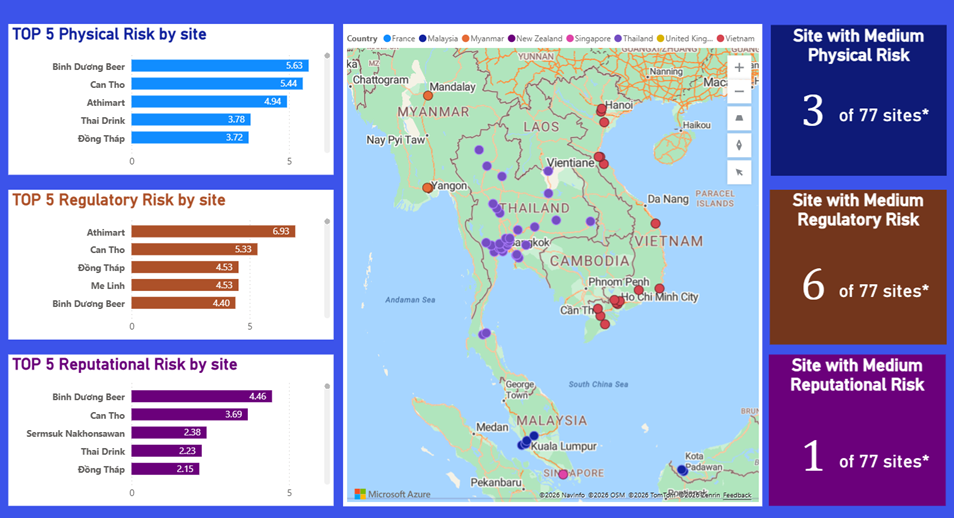
Based on the Water Sustainability Assessment, ThaiBev developed the Water Risk Tool to systematically assess and monitor water-related risks across its production facilities on an annual basis. The tool translates the assessment findings on water dependencies, impacts, and vulnerabilities into three main risk categories: Physical Risk, related to water quantity and quality; Regulatory Risk, related to legal and compliance requirements; and Reputational Risk, related to stakeholder concerns and perceptions.
The results are consolidated in the ThaiBev Water Risk Dashboard, which enables ThaiBev to monitor and prioritize water-related risks across its production facilities. The dashboard identifies sites with elevated risk levels, highlights the top five sites with the highest scores under Physical, Regulatory, and Reputational Risks, tracks historical risk trends over the past three years, and assesses future scenarios, including potential changes in water quantity and quality. The results support the development and monitoring of appropriate mitigation and adaptation measures.
Key Results
Based on the FY2025 Water Risk Dashboard, 3 of 77 assessed sites were identified with Medium Physical Risk, 6 sites with Medium Regulatory Risk, and 1 site with Medium Reputational Risk. These results enable ThaiBev to prioritize sites requiring further assessment and appropriate risk management measures.
In FY2025, ThaiBev experienced no operational impacts from physical water-related business risks.
Color Legend
 Physical Risk (Quantity and Quality)
 Regulatory Risk
 Reputational Risk
Score Explanation
Low Risk: 0-4
Medium Risk: 4-7
High Risk: 7-9
Note: ThaiBev has 80 production sites, while the FY2025 Water Risk Dashboard covers 77 sites, as three ThaiDrinks facilities are co-located with Spirits facilities in Thailand.