ThaiBev’s Sustainability 2025
Home / Environmental
Food Loss and Waste
According to the United Nations, at least one-third of all food produced globally is lost or wasted. This inefficiency not only exacerbates global food insecurity but also contributes significantly to climate change. When food waste decomposes in landfills, it generates methane—one of the most potent greenhouse gases that contribute significantly to global warming—making food loss and waste responsible for an estimated 8-10 percent of global greenhouse gas (GHG) emissions, according to the UN Environment Programme.

To address this challenge, ThaiBev is actively working to reduce food loss and waste across its operations by minimizing waste sent to landfills and enhancing resource efficiency. By prioritizing reduction and reuse strategies, the company aims to mitigate its environmental impact while supporting long-term sustainable growth.
Management Approach
ThaiBev has committed to achieving zero food loss and waste to landfills by 2030. To support this target, the company follows the United Nations Environment Programme’s “Mapping and Measuring Food and Drink Waste” module, which prioritizes strategies according to the Food and Drink Material Hierarchy: Prevention, Optimization, Recycling, Recovery, and Disposal. Across the Beer, Spirits, and Non-Alcoholic Beverage Product Groups, potential food loss is being repurposed and reintegrated into the production process, resulting in zero food loss sent to landfills.

In the Food Product Group (Thailand), a dedicated Food Loss and Waste Management Working Team, composed of directors and managers from restaurant and food production operations, was established in 2020 to oversee food loss and waste at production sites and retail outlets. Building on this, in late 2021, ThaiBev launched a collaborative project with internal partners including FEED Addition, Thai Beverage Recycle (TBR), and HAVI Logistics to monitor and manage food loss and waste across the value chain. The project aims to divert materials from landfills and explore opportunities to generate income from food loss and waste in addition to donations.
Management Process
The terms “Food Loss” and “Food Waste” refer to different stages in the value chain. Food Loss occurs at harvesting, transportation, and production sites; whereas Food Waste occurs at retail and consumption stages.

Aligned with the United Nations Sustainable Development Goals (UNSDGs) Target 12.3 to halve global food loss and waste per capita by 2030, ThaiBev has set an even more ambitious target in order to push for proactive actions across the company: to achieve zero food loss and waste to landfill by 2030. This requires that all food loss and waste generated across operations be diverted for utilization elsewhere rather than landfilled.

To achieve this, ThaiBev has implemented initiatives across its four Product Groups to minimize the volume of food loss and waste generated and to reduce landfill disposal. These efforts include campaigns to raise consumer awareness, programs to repurpose surplus food, and comprehensive monitoring systems. At production sites, food loss is systematically accumulated, measured, categorized, and stored to trace its origin and identify areas for improvement. During distribution, food loss is assessed by weight differences between full and empty truckloads; while at the retail level, food waste is weighed at each individual restaurant and subsequently calculated and recorded in the inventory system.

Data from production facility in Chon Buri Province and retail outlets across Thailand is collected by the assigned data collectors via the Sustainability Data Management System (SDMS), aggregated by analysts, and reviewed by the Project Management Office to guide continuous improvements in food loss and waste reduction processes.
Targets
Zero
food loss and waste to landfill
by 2030
Remark: Excluding F&N operations.

Food Loss
ThaiBev categorizes food loss from its production facilities into different categories—including fish scraps, vegetable scraps, bread crumbs, and other food scraps—while tracking their respective monthly volume and disposal methods; whether sold to suppliers, donated for animal feed, or repurposed into new products. The company collaborates with suppliers to ensure raw materials meet quality standards, reducing losses from packaging or transport, and continuously explores new uses for food loss that may generate returns. In 2025, ThaiBev expanded food loss data collection to include F&N operations, covering their international Non-Alcoholic Beverage and Food factories

Food Waste
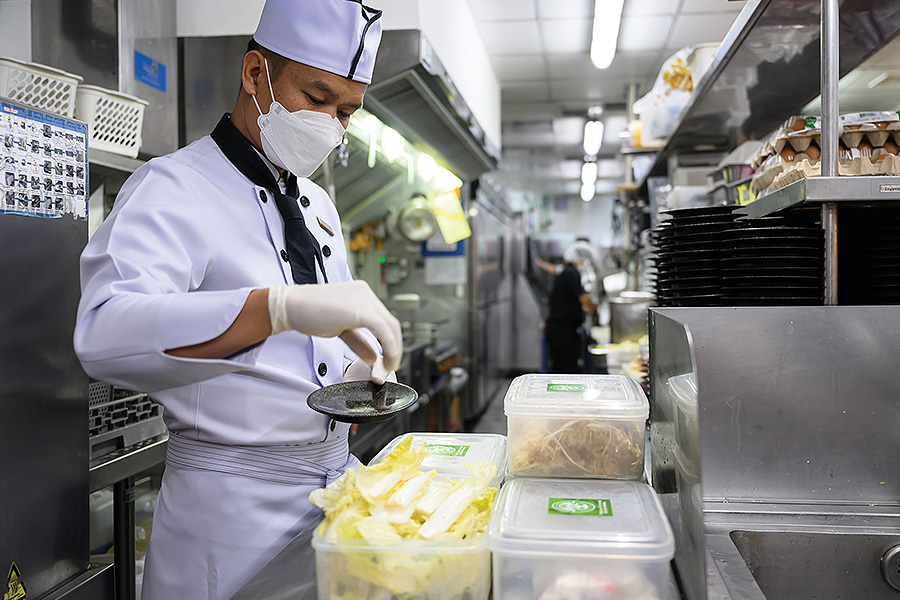
ThaiBev continues to improve the accuracy of food waste data from its restaurants in Thailand— including restaurants under Oishi, QSA, and FOA brands—to better reflect operational realities and identify areas for improvement. As food can quickly expire, food waste is handled swiftly with licensed logistics partners to maintain hygiene and safety. ThaiBev also explores value-added uses for food waste, such as repurposing unused ingredients into new products, and donating surplus food to communities. By the end of 2025, the scope of food waste data collection was extended to all current restaurant operations, achieving full coverage of food waste monitoring.
Key Projects

“Tod Mai Ting” and “Mai Tod Sum” Campaign (“Fry and Fly” and “No Refry”)
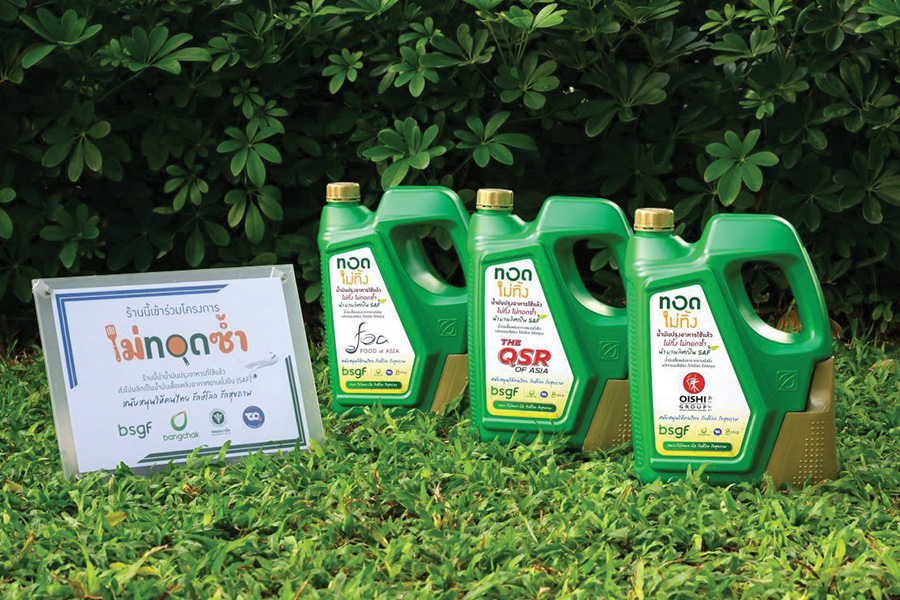
Used cooking oil from ThaiBev’s Food Product Group operations in Thailand is eligible to be repurposed into biofuel, so we actively seek out business partners who are willing to purchase our used cooking oil for this purpose. This results in value generation for both sides while also helping to mitigate climate change. In 2024, the Food Product Group (Thailand) announced a collaboration with BSGF Company Limited (BSGF)—a joint venture under Bangchak Oil Refinery and Retail Gas Station Group—to drive best practice for managing used cooking oil by collecting the oil and reusing it as a raw material for sustainable aviation fuel (SAF), which can reduce carbon emissions by approximately 80 percent compared to traditional aviation fuel. In 2025, under this initiative, 1,401,538 kilograms of used cooking oil from restaurants were sold to produce biofuel, generating income of around 40.94 million Baht

Zero Food Waste Challenge
Shabushi, which is ThaiBev’s buffet-style Shabu restaurant chain, has created the “Kin Mod Kliang” challenge for its customers. “Kin Mod Kliang” means “Eat it all so there’s no food waste,” reminding people to consider reducing their leftovers by not serving themselves more than they can eat. The challenge has since been adopted by all of ThaiBev’s buffet-style restaurants across Thailand, with approximately 307,886 customers participating in 2025.

KFC Harvest Program
In this program, surplus food is donated directly to people living in disadvantaged circumstances. The QSR of Asia, or QSA—ThaiBev’s Food Product Group business unit which oversees the management of the company’s KFC restaurant branches in Thailand—provides surplus food to vocational institutes across Thailand, along with the Scholars of Sustenance (SOS) Foundation. In 2025, KFC restaurants under QSA’s operations donated a total of 17,825 kilograms of high-quality food, which is worth approximately 1.79 million Baht.

Food Surplus Donation in Collaboration with the Scholars of Sustenance (SOS) Foundation
ThaiBev’s Food Product Group works with the SOS Foundation to donate food surplus to various vulnerable communities. The foundation works with restaurants to pick up food surplus (either raw or cooked) that is still of high quality and edible. Restaurants are given instructions on how to store the food, including whether containers are necessary, and what food categories are accepted, to ensure the safety of those receiving the food. In 2025, a total of 2,300 kilograms of food surplus was donated, which is worth approximately 139,858 Baht.

Achievements
Food Loss and Waste in Food Production Facility and Restaurant
Details of Food Loss and Waste Performance in 2025 % Food Waste to Landfill
Total Food Loss and Waste 3,581.20 tonnes 47.27%
Total Food Loss and Waste Utilized for Alternative Purposes 1,888.20 tonnes
Total Food Waste Discarded 1,693.00 tonnes
1,888.20 tonnes
of food loss and waste was utilized for alternative purposes. The breakdown was as follows:
  • Food loss and waste donated as animal feed: 418.04 tonnes
  • Food waste donated: 20.96 tonnes
  • Food waste repurposed into fertilizer: 0.42 tonnes
  • Food waste repurposed and sold as by-products: 35.20 tonnes
  • Food waste sold to produce biodiesel: 1,413.58 tonnes
Food Loss in Beverages’ Production Facilities
100%
of expired / rejected beverage products (2,533.52 m3) were treated and utilized for alternative purposes.
Moving Forward
In 2025, ThaiBev’s Food Group continued to explore collaborations with various stakeholders aimed at reducing food waste sent to landfills from the company’s restaurants. Discussions were held with various landlords, such as the mall owners, and the Bangkok Metropolitan Administration (BMA). Engagements have taken place with all the major landlords where ThaiBev’s restaurants are located, resulting in agreements with one major landlord, while discussions with others remain ongoing. In collaboration with the BMA, directions have been sent to each Bangkok district where ThaiBev’s standalone restaurants operate, enabling local coordination between district offices and the company’s restaurants. Food waste management processes may vary across districts depending on available infrastructure and local preferences.

For existing food waste management initiatives already implemented by landlords, ThaiBev will conduct regular reviews to assess whether each project receives sufficient engagement and cooperation from tenants. In cases where participation remains limited, ThaiBev plans to work with landlords to identify ways ThaiBev can help promote, enhance, and encourage greater tenant involvement in these initiatives.

Moving forward, the next steps include gradually integrating food waste management programs across shopping malls as planned, finalizing agreements with the remaining major landlords, and reaching out to smaller landlords to expand the initiative’s scope. For standalone restaurants, ThaiBev will continue strengthening coordination with district offices to bridge communication gaps and advance collaboration between ThaiBev and local authorities.

Read More Information about
Food Loss and Waste
in Sustainability Report 2025