Humanity generates more than two billion tonnes of waste globally
each year, with municipal waste accounting for a significant proportion.
The continuous rise in waste generation is driven by population growth,
urbanization, and changing consumption patterns—all of which place
increasing pressure on natural resources and ecosystems worldwide.
Current waste management trends indicate that up to 37 percent
of waste is still disposed of via landfill, including both controlled landfill
and open dumping. Although landfill disposal remains popular due to
its low cost, it has far-reaching environmental impacts, such as leachate
contamination of soil and groundwater, loss of productive land, and the
release of methane—a greenhouse gas with a global warming potential
many times greater than carbon dioxide.
In response to these challenges, ThaiBev has adopted the circular
economy concept and the 3Rs principle (Reduce, Reuse, Recycle)
to minimize the amount of waste sent to landfills. The company
is committed to achieving zero waste to landfill from its production
facilities in Thailand and Myanmar by 2040.
Management Approach
ThaiBev recognizes the importance of effective waste management in mitigating environmental impacts and creating value for society. The company is committed to implementing the Circular Economy approach and the 3Rs principle (Reduce, Reuse, Recycle) to efficiently utilize resources, reduce waste at the source, and expand opportunities for creative reuse and recycling.
ThaiBev has also initiated various projects and collaborated with stakeholders across all sectors to drive waste
reduction within production processes, improve
post-consumer packaging management, and support
the use of waste for renewable energy production—
all of which help reduce reliance on natural resources
and mitigate long-term environmental impacts.
Within its operations, ThaiBev focuses on the efficient
use of resources and the reduction of waste generation
throughout production processes. This approach not only conserves natural resources but also reduces
environmental impacts and waste management costs.
To ensure systematic and effective waste management,
the company applies the Waste Management Hierarchy, which consists of six key stages:
Prevention – Improve and optimize production processes to reduce waste from the outset by using fewer materials and avoiding unnecessary resource use.
Minimization – Reduce waste across the entire value chain through more efficient product design and production processes.
Reuse – Promote the continued use of items and materials to reduce waste, conserve resources,
and preserve value throughout the supply chain.
Recycling – Collect and process unused materials for reuse as raw materials in new products, reducing both natural resource consumption and the volum
e of waste requiring disposal.
Energy Recovery – Convert non-recyclable waste into alternative energy sources such as heat, electricity,
or fuel to maximize the usable value of waste.
Disposal – Properly and safely dispose of remaining waste in compliance with environmental protection
and public health standards.
These initiatives reflect ThaiBev’s strong commitment to conducting business responsibly toward the environment and society, while creating long-term value and promoting sustainable growth. The company believes that
effective and sustainable waste management is not only
a corporate responsibility but also a key driver in
advancing the global green economy—paving the way toward a better future for all.
Targets
Zero Waste
to Landfill
(in Thailand and Myanmar)
by 2040
Zero Waste to Landfill Certificate
ThaiBev continues to strengthen its waste management practices and accelerate the transition towards a circular economy, with a long-term commitment to achieving Zero Waste to Landfill in Thailand and Myanmar by 2040.
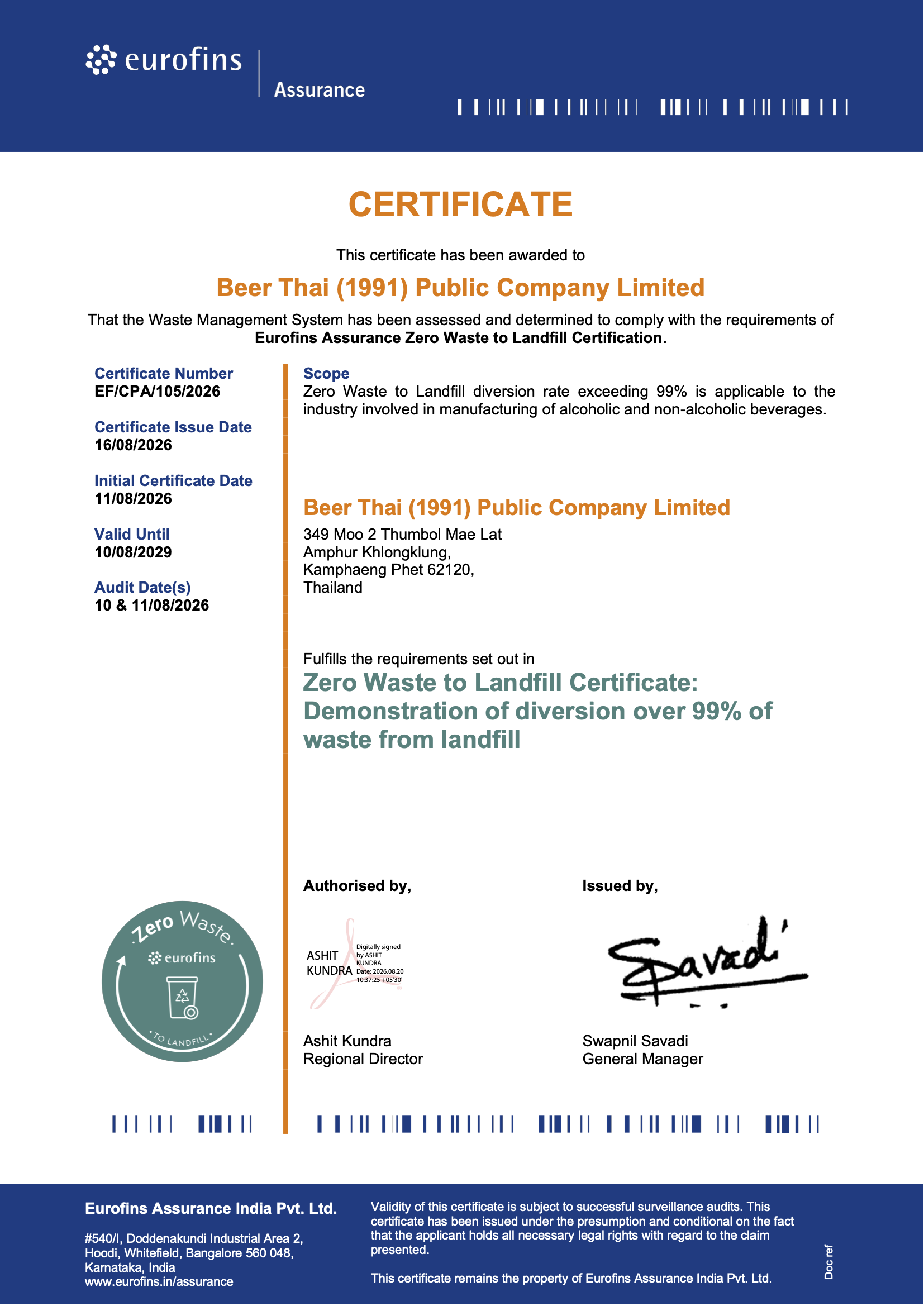
Beer Thai (1991) Public Company Limited achieved the Eurofins Zero Waste to Landfill Certification – the highest certification level, demonstrating a waste diversion rate of more than 99% from landfill. This achievement means that more than 99% of the waste generated at the brewery was diverted from landfill through recycling, reuse, recovery, composting, and other appropriate treatment methods.
Target to achieve Zero Waste to Landfill in Thailand and Myanmar
The certification was supported by a comprehensive assessment of waste management practices, including waste data and documentation, waste segregation and handling, legal compliance, and verification of waste treatment and disposal routes. The process also enhanced the traceability and transparency of waste throughout the waste management value chain.
Building on this achievement, ThaiBev will use the certification criteria as a practical framework for continuous improvement and future implementation across its operations. The Company will continue to focus on reducing waste generation, increasing recycling and resource recovery, and minimizing waste sent to landfill, supporting its ambition to achieve Zero Waste to Landfill by 2040.
Key Projects
Waste management & Circularity
Zero Waste to Landfill Project
Through its Spirits Business Group in Thailand, ThaiBev has implemented the Zero Waste to Landfill Project as a key action plan to reduce waste generation and achieve zero landfill waste, in line with the company’s environmental targets. The project has been successfully piloted at Athimart Distillery in Buriram Province, Thailand, and encompasses waste management across the entire value chain—upstream, midstream, and downstream—through the following waste reduction actions:
Waste reduction at the source: Promoting environmental awareness among employees and encouraging the use of eco-friendly packaging, such as foam-free food containers and reusable cups. Implementing waste segregation systems in both factories and employee housing to ensure efficient management of all waste streams.
Organic waste management: Utilizing food waste for composting to support the factory’s self-sufficient agriculture plots and producing biochar for use as fuel and odor-absorbing material.
Recyclable and hazardous waste management: Selling recyclable materials and ensuring hazardous waste is properly treated by licensed waste management contractors.
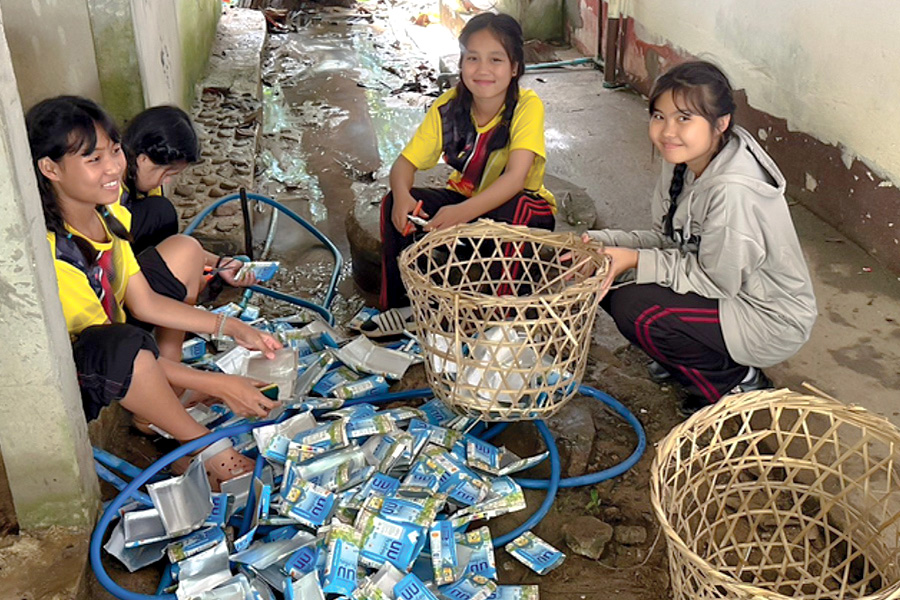
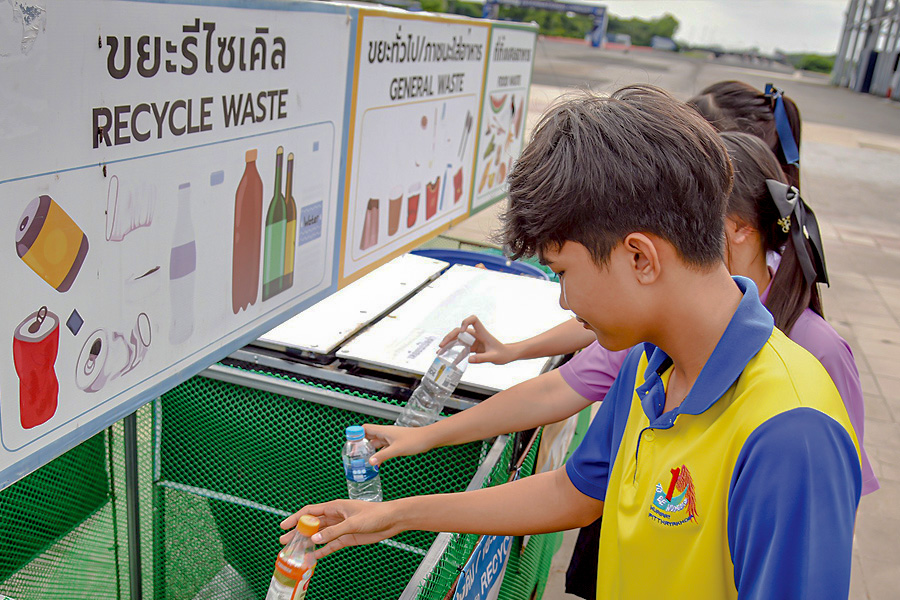
Community engagement: Under the concept "Sustainability from Factory to Community," the waste management team conducted training sessions for 130 students from Ban Srakosai School and Ban Sai Ngam School, as well as local residents in Ban Sai Ngam community. The sessions promoted knowledge on waste segregation and recycling value enhancement, alongside the donation of recycling bins to the schools.
These action plans focus on preventing waste generation, maximizing resource recovery, and minimizing waste sent to landfill through continuous improvement, stakeholder engagement, and circular waste management practices. The Zero Waste to Landfill Project serves as a model of integrated waste management, not only reducing waste sent to landfill but also fostering a sustainable corporate culture and extending its positive impact to surrounding communities.
Spent Malt and Yeast Project for the
Animal Feed Industry
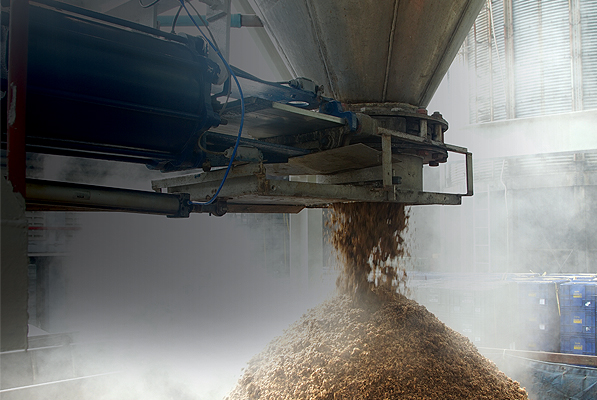
In the beer production process, malt and yeast are the primary raw materials. After brewing, these materials become by-products known as “spent malt” and “spent yeast.” Both by-products retain nutritional benefits for agricultural use and can be used as feed ingredients in
the animal feed industry. Spent malt and yeast are rich in protein, making them ideal for use as feed for various types of animals such as dairy cow, beef cattle, poultry, and pets. In 2025, the breweries successfully managed and utilized
a total of 39,285 tonnes of by-products from the beer production process for use as animal feed, comprising 38,281 tonnes of spent malt and 1,004 tonnes of spent yeast.
Granular Ash as Soil Conditioner
The production process at Surabangyikhan Distillery in Pathum Thani Province generates powdered ash from the evaporation and incineration of vinasse, effluent from the distillery process, to produce steam for internal use. This powdered ash is notable for its high potassium content—an essential plant nutrient—which can be used in the production of organic fertilizers or soil amendments. As part of the Company's integrated recycling programme to reduce waste from its own operations sent to landfill, the granular ash is recovered and beneficially reused as a soil conditioner, supporting resource circularity while minimising landfill disposal.
Waste Audit
ThaiBev have a team responsible for ISO 14001 certification. across all business divisions and launched a comprehensive waste audit initiative as part of its commitment to achieving zero waste to landfill by 2040. This program aims to assess the waste data of each production process , analyze waste data in order to reduce the amount of waste going to landfill, and identify opportunity for improving waste performance.
Waste Reduction Training to Employee
Encouraging Employees to Participate in Waste Reduction by Separating Waste To reduce the amount of waste sent to landfills and promote the most efficient use of resources through the 3Rs principle, ThaiBev’s production facilities have launched a campaign to create awareness among employees about the benefits of waste separation and the value that can be added to recyclable waste. The results of the campaign are as follows:Reduction of waste within the factories and to landfill
Ability to recycle waste for other uses
Creating teamwork among employees
Reducing costs and adding value to waste
Reducing waste-related impacts and protecting the environment
Waste-to-Value and Circular Innovation, Thailand
ThaiBev continues to invest in innovation and research and development (R&D) to minimize waste, improve resource efficiency, and create value from waste and by-products. Through its collaboration with SPACE-F, Thailand's first FoodTech incubator and accelerator, ThaiBev supported five innovative projects that transform waste and underutilized resources into value-added products and sustainable solutions, including
Coffee cherry husks into health food supplements
Cocoa husks into animal feed for low-carbon beef production
Shrimp processing waste into bioplastics and biopesticides
Ripe fruits into premium products
Algae into drinking straws.
As a corporate partner, ThaiBev provides startups with access to its business units and production facilities for technology validation and proof-of-concept trials under real commercial conditions. This collaboration enables ThaiBev to access emerging technologies, specialized expertise, and innovative solutions while supporting startups in developing technologies with practical applications.
At the operational level, ThaiBev's manufacturing facilities continuously improve waste management through enhanced waste segregation, optimized disposal methods, and initiatives based on the 3Rs principle. In addition, ThaiBev has invested in the development and testing of a soil amendment formulation made from waste generated within the Group. A field trial was conducted on kale at a farmer's plot near the SangSom Kanchanaburi Distillery, demonstrating the Company's continued efforts to convert waste into value-added agricultural inputs.
Community and Social Engagement Waste
Programs
Community Segregation & Recycling
ThaiBev has implemented multiple waste segregation
and recycling campaigns in communities across Thailand, namely Chiang Dao District in Chiang Mai Province,
Central Police Flat Community (Chalermlap) in Bangkok, Sichang Island in Chon Buri Province, and local communities
surrounding our production facilities. These programs involve community workshops on waste segregation, training on the value of recyclables, providing waste bins and collection logistics, and purchasing recyclable
packaging waste to help generate local income.
As part of Chiang Dao District Area-Based Development Project in Chiang Mai Province, ThaiBev, in collaboration with the Mae Fah Luang Foundation under Royal
Patronage, promotes household-level waste segregation at three pilot villages—Ban Mae Mae, Ban Mae Sai,
and Ban Pang Ma-O in Mae Na Sub-district-remote areas that previously lacked access to local waste management systems. More than 220 households have participated in waste segregation activities, leading to a significant reduction in general waste within the villages. As a result, the upstream area is now free from littering and waste dumping in forest areas, while communities earn additional income from selling recyclable waste. The project has a total operational budget of
1.6 million Baht. The ultimate goal is to establish
Mae Na Sub-district as a model community for
sustainable waste management.
ThaiBev partnered with Central Police Flat Community (Chalermlap) in Bangkok to improve waste
management systems. In 2023. ThaiBev has provided waste segregation bins along with collection logistics for recyclable packaging waste, and purchases it through Thai Beverage Recycle Co., Ltd (TBR) to generate income for the local community. In the upcoming year, we aim to increase resident participation and expand segregation of additional waste types for income generation and proper management, ultimately reducing the amount
of waste requiring disposal and aligning with Bangkok’s waste management goals.
Extending from the Island Model implemented by
TBR to address the unique challenges of managing post-consumption packaging on islands, ThaiBev in collaboration with Siam Cement Group (SCG), is working in tandem with local authorities, waste collectors, scrap shops, and community leaders to set up an integrated waste management system for Sichang Island.
The ultimate goal is to establish a scalable waste
management model that can be applied to other islands facing similar challenges, while reducing the amount
of waste discarded to landfill.
School Waste Management Project
The School Waste Management Project aims to raise awareness, instill environmental consciousness,
and promote responsible waste management behaviors among students. The initiative engages participants
from the Partnership School Project, Connext ED, and the Our Khung Bangkachao Conservation and Development Project, providing opportunities for students to learn and practice proper waste segregation and sustainable waste management with the goal of achieving zero landfill waste.
In collaboration with ThaiBev, the Thailand Institute of Packaging and Recycling Management for Sustainable Environment (TIPMSE), provided expert knowledge on effective school waste management practices for students in Buriram Province. In 2025, a total of over 800 students from 106 schools participated in the program, gaining hands-on experience in proper waste segregation.
In 2025, the schools participating in this program
successfully collected and separated 327 kilograms of recyclable materials. Additionally, students implemented effective food waste management, helping reduce landfill waste by 1,186 kilograms.
This initiative not only strengthens students’
understanding of sustainability but also empowers
them to become environmental stewards, fostering
a culture of responsibility and circular economy thinking within their schools and communities.
Distributing Soil Conditioner to Local Farmers
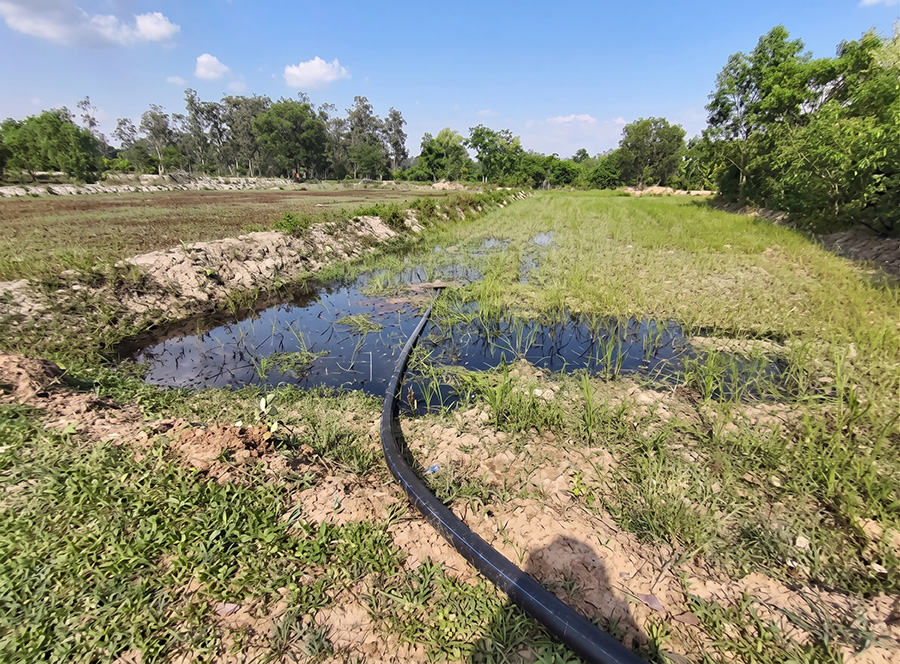
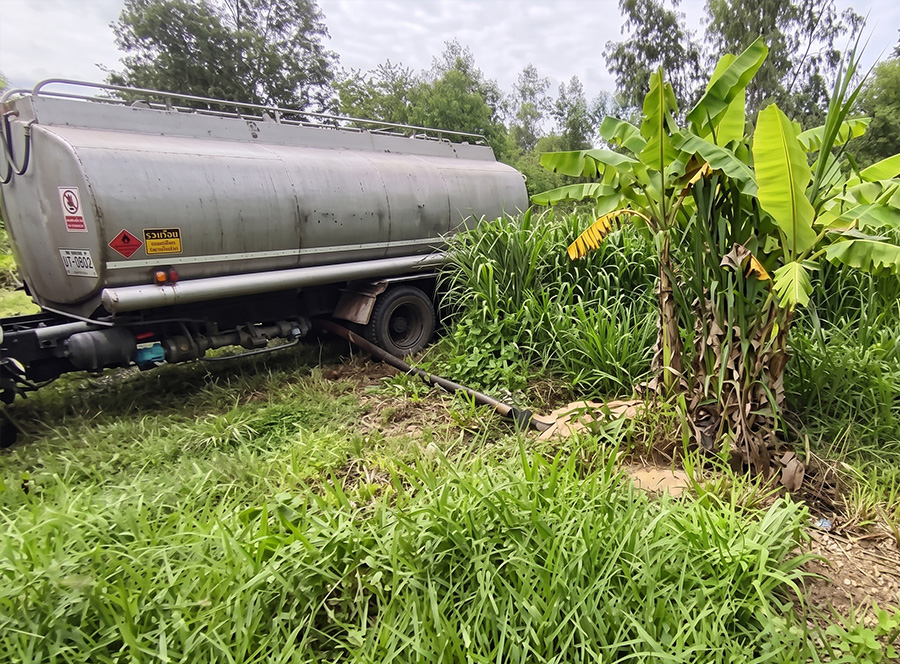
ThaiBev distributes distillery slop, effluent from the biogas production process in spirits production facilities in Thailand, as a soil conditioner to local farmers, because it contains essential nutrients for plant growth, particularly for sugarcane. Research has found that distillery slop increases sugarcane yields without causing negative environmental impacts. It can reduce farmers’ outgoings on chemical fertilizers (approximately 1,200 baht per rai) and result in an increased yield of approximately 10,000–15,000 Baht per rai.
In 2025, ThaiBev distributed distillery slop to 775 farmers from 13 distillery facilities across Thailand, totaling more than 969,245 cubic meters and covering over 38,390 rai (6,142 hectares) of sugarcane fields, rice paddy fields, corn fields, grass and other plant farms.
Moving Forward
ThaiBev has begun its journey toward achieving the goal of “Zero Waste to Landfill (in Thailand and Myanmar)
by 2040” at all of its production facilities. The company aims to minimize landfill disposal as much as possible by prioritizing waste recovery, reuse, and environmentally sound treatment methods. These efforts have significantly reduced the volume of waste sent to landfill.
By 2026, ThaiBev will establish short-, medium-, and long-term targets, as well as develop a baseline to monitor
waste quantities and identify hotspots that require improvement. A clear roadmap and timeline will also be
developed to guide the implementation.
In addition, ThaiBev places strong emphasis on the accurate, comprehensive, and systematic management of
waste data across its domestic and international operations including the reutilization of waste to achieve the highest possible value. Waste is categorized by type and disposal method to establish a reliable database for strategic planning and performance monitoring. This process forms a crucial part of the company’s long-term strategy to achieve zero waste to landfill.