Targets
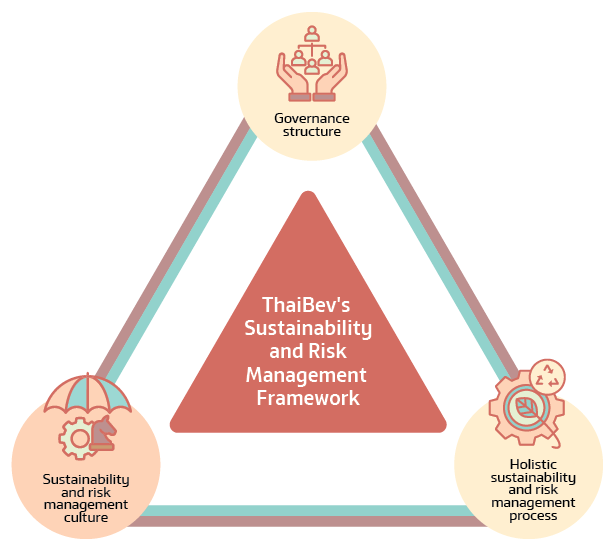
In response to mounting environmental challenges, societal transformations, and heightened geopolitical uncertainties, ThaiBev recognizes that traditional risk management—
focused primarily on planning and mitigating well-defined risks—is no longer sufficient. To address the evolving complexity of the business landscape, the company has broadened its approach to include resilience management. This holistic strategy emphasizes strategic preparedness, robust response capabilities, and adaptive capacity, enabling rapid recovery from disruptions and ensuring sustained operational and financial performance in the face of crises, climate-related risks, and market uncertainties.
1. Financial Resilience
ThaiBev maintains a balanced approach to short- and long-term expenditures and strategically manages funding sources in line with investment and commercial objectives. By upholding a strong capital base and ample liquidity,
the company is well-positioned to withstand revenue fluctuations, rising costs, and financial market volatility, safeguarding its long-term stability and growth.
2. Operational Resilience
Through adaptable and resilient production systems, ThaiBev is able to respond swiftly to shifts in demand
while maintaining uncompromised quality standards.
The company reinforces its supply chain and distribution networks by engaging closely with business partners, ensuring continuity of operations and reliable delivery
even amid supplier disruptions, natural disasters,
or geopolitical events.
3. Technological Resilience
Investments in secure, flexible, and resilient information technology infrastructure enable ThaiBev to manage cyber threats and technological disruptions effectively.
Continuous development of digital competencies and comprehensive business continuity and disaster recovery plans ensure uninterrupted service delivery and seamless internal operations.
4. Organizational and Reputational Resilience
ThaiBev upholds a clear mission, core values, and strategic framework that guide business conduct and ESG practices. Through active and transparent engagement with
stakeholders, the company responds proactively to societal expectations, strengthening accountability, trust,
and long-term stakeholder confidence.
5. Business Model Resilience
Designed to adapt to dynamic market conditions,
regulatory changes, and technological advancements, ThaiBev’s business model leverages the Transformation Program and PASSION 2030 strategy. These initiatives drive innovation, expand product offerings, optimize sales channels, strengthen sustainability collaborations, and enhance competitiveness in Thailand, Vietnam, Myanmar, Singapore, and Malaysia. Strategic focus also includes increasing shareholder value, reinforcing supply chains, digitalizing processes, and cultivating a skilled workforce.
6. Climate Resilience
ThaiBev continually advances its climate risk and
opportunity management across short-, medium-,
and long-term horizons. Through detailed scenario analyses, capacity-building programs, and measurable targets, the company ensures accountability for climate-
related initiatives. Key actions include improving resource efficiency, promoting material circularity, developing low-carbon products, engaging suppliers, and
implementing reforestation programs. ThaiBev’s Net-Zero targets, approved by the Science Based Targets initiative (SBTi), align with global efforts to limit temperature rise, mitigating climate impacts across operations and the
value chain while seizing opportunities in the transition
to a low-carbon economy.
By combining foresight, stakeholder insights, scenario planning, and tested crisis response protocols, ThaiBev proactively identifies potential resilience gaps and ensures timely, effective action. This integrated approach reinforces the company’s capacity to safeguard operations, protect its reputation, and sustain long-term growth while fulfilling its commitment to resilience and sustainability.